
How much do Colombians work?

Most Colombian migrants leave for work-related reasons. We’ve left our country in search of better opportunities. Perhaps because of this, and because humans tend to obsess over contemplating the lives we chose not to live, Colombians abroad often find ourselves thinking about the world of work in Colombia. Today, I feel like talking about this, and I’d like to start by addressing the most basic question: how much do Colombians work?
To begin with, work hours in Colombia are quite long. While in the U.S., the phrase used to describe a typical office job is something like “a 9-to-5 job,” in Colombia, the equivalent is “an 8-to-5 job.” For example, it’s common for banks in Colombia—a broad reference point for the formal sector—to open at 8 a.m. Some even have extended hours until 8 p.m. This is something I haven’t seen in any other country I’ve lived in, except for the United Arab Emirates, which has a rather atypical labor market. I could also mention the 6 a.m. classes I’ve only seen at universities in Colombia, but I don’t think I need more examples to convince you of how prevalent and normalized long work hours are in the country.
Paradoxically, these extended work hours coexist with a calendar full of holidays, with periods like Holy Week and December when many sectors don’t work, with attitudes that accept arriving 15 minutes late and leaving 15 minutes early, and with a culture where it’s normal to spend half the workday chatting about non-work topics with colleagues and clients.
It’s no surprise, then, that Colombia appears in very different positions across various global indices of hours worked. While there are interesting methodological discussions about the correct way to estimate this, I think it’s more valuable to reflect on the quality of those hours rather than their quantity.
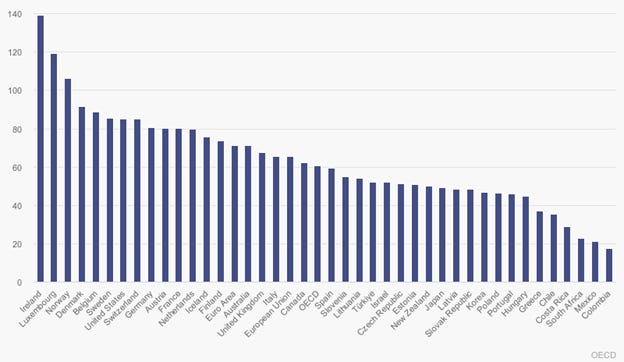
When I talk about the quality of work hours, I’m referring to what economists call productivity—i.e., the value generated per hour worked. Here, there’s less controversy regarding Colombia. Despite uncertainties about accurately estimating hours worked, most experts would agree that the average Colombian is not very productive. According to the OECD, Colombia has the lowest labor productivity in the organization (Figure 1).
Figure 1. Labor Productivity. Output per hour worked. 2021.
Source: OECD
Unfortunately, conversations about labor productivity often quickly turn to cultural arguments, like those I mentioned a couple of paragraphs ago. For example, it’s said that a German works 7 hours a day, but those are 7 net hours of work, undiluted by tardiness or personal conversations. While there’s some truth to this, it’s unfortunate because it ignores that most productivity depends on factors beyond labor itself, and while work culture matters, it is often shaped by those factors as well.
What do I mean by this? First, producing requires more than just effort. Even the person with the most admirable work ethic won’t be particularly productive without access to the right capital and technology. And it’s not just about having the right conditions within the firm where one works. If, upon leaving the firm, its output encounters a world without roads to transport it quickly to market, if there’s no security to ensure it arrives without issues, if bureaucratic red tape delays and increases the cost of selling to consumers, etc., the value generated by that initial person will be deeply limited. In other words, aggregate labor productivity figures reflect the dysfunctions of economies outside of firms.
Precisely because a firm’s production is not independent of the broader system, a functional productive apparatus forces firms to be more productive within their organizations. In fact, this is how disciplined work cultures emerge. Contrary to what many think, countries now recognized for their intense work cultures, like Singapore or South Korea, were described as places populated by lazy and unproductive communities during the 19th century. While those descriptions were often steeped in the racism and ignorance of their observers—mostly European travelers and colonial officials—it’s clear that the productivity of these societies grew systematically as their economies grew. The reason is that productivity within firms responds to external incentives. A firm operating in an ecosystem with highly productive suppliers and clients must achieve similar productivity levels or be wiped out of the market.
Once you understand this, it shouldn’t be surprising to learn that, in Colombia, despite low aggregate productivity levels, there are a few oases of firms with productivity levels equivalent to those of developed economies. Think of companies like Ecopetrol, Promigas, or Nutresa, for example.
So, the fact that Colombians work long hours with low effectiveness is not a reflection of a structural failure in our culture as workers or entrepreneurs. It’s an expression of a society that collectively has not prioritized building a robust and competitive productive apparatus. As long as this isn’t a priority in public discussion, the situation won’t change, and Colombians will continue to work many hours while generating little value.